Introduction
Salt Typhoon Cyberattack 2025: How Chinese Hackers Targeted Millions of American
In 2025, the United States faced one of the biggest cyber threats in history—the Salt Typhoon cyberattack. Linked to Chinese state-backed hackers, this operation targeted U.S. telecommunications networks, potentially exposing sensitive data of millions of Americans. Unlike smaller breaches that leak emails or passwords, this attack dug deep into the nation’s critical infrastructure, raising serious questions about national security, privacy, and the future of cyber defense.
Table of Contents
What Is the Salt Typhoon Cyberattack?
The Salt Typhoon cyberattack is the name given to a massive espionage campaign attributed to hackers connected with the Chinese government. According to U.S. officials, the hackers infiltrated major telecom companies, gaining access to:
- Call metadata (who contacted whom, when, and how often).
- Location information (where calls originated).
- In limited cases, private communications (voice, text, and data).
This wasn’t a simple phishing scheme. Instead, Salt Typhoon used sophisticated methods, including exploiting vulnerabilities in Cisco routers and telecom infrastructure, allowing them to hide in plain sight inside U.S. networks.
How Did It Happen?
Investigators believe the hackers entered through unpatched security flaws in core telecom equipment. Once inside, they established persistence and quietly siphoned data for years without being detected.
Key techniques included:
- Exploiting hardware vulnerabilities in internet backbone providers.
- Creating hidden access points for long-term spying.
- Targeting U.S. telecom giants such as AT&T, Verizon, and other network carriers.
- Blending in with normal traffic so their activity looked legitimate.
This shows that Salt Typhoon wasn’t just a random group of hackers—it was a well-funded, state-directed cyber operation.
Why This Attack Matters
While many Americans are used to hearing about data breaches from companies like Target or Equifax, the Salt Typhoon attack is far more dangerous because:
- It hit critical infrastructure (telecoms are the backbone of communication).
- It exposed not just data, but patterns of behavior—who talks to whom, when, and where.
- It shows that foreign adversaries can penetrate U.S. networks at scale.
- It has national security implications, since government officials, military members, and businesses all use the same networks.
Experts warn that such access could be used not only for spying but also for future sabotage, like shutting down networks during a conflict.
Government Response
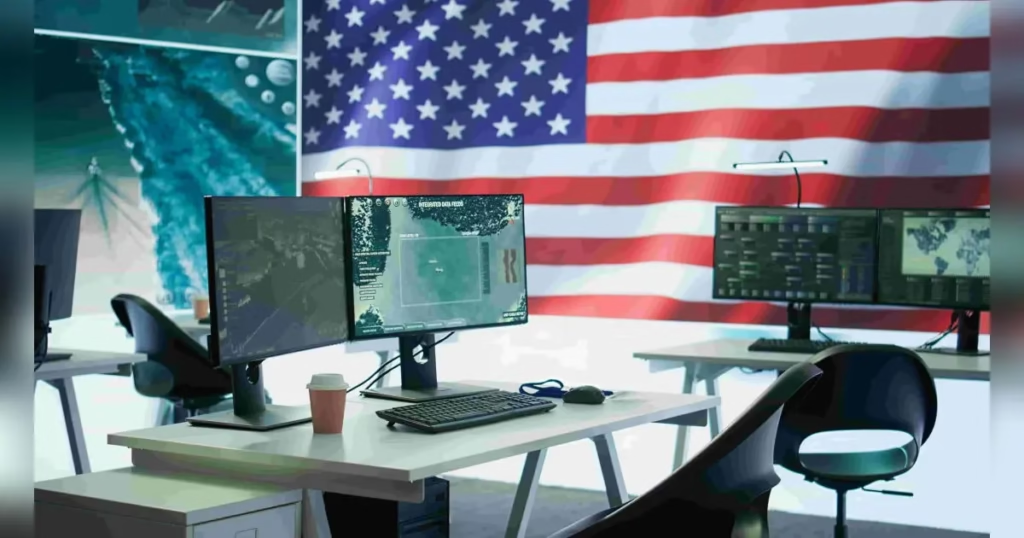
The U.S. government has already:
- Issued sanctions against Chinese tech firms linked to the breach.
- Ordered telecom companies to patch vulnerabilities and strengthen defenses.
- Launched investigations through agencies like the Cybersecurity and Infrastructure Security Agency (CISA) and the National Security Agency (NSA).
- Briefed Congress on the scale of the attack, calling it one of the most serious cyber intrusions in U.S. history.
But experts say removing hackers from telecom infrastructure is extremely difficult—once inside, they can build backdoors that are hard to fully eliminate.
How It Affects Americans
Even if you weren’t specifically targeted, Salt Typhoon may have impacted you indirectly. Here’s how:
- Your call metadata may have been collected.
- Your phone location history could have been exposed.
- Your privacy risk increases, as data can be pieced together to build profiles.
- If you’re in a sensitive job (military, government, corporate leadership), you may have been a priority target.
In simple terms, Salt Typhoon wasn’t about stealing your Netflix password—it was about mapping America’s digital heartbeat.
How to Protect Yourself
While individuals can’t stop nation-state hackers alone, you can still reduce your risks:
- Use strong, unique passwords for all accounts.
- Enable two-factor authentication (2FA) wherever possible.
- Keep your devices updated with the latest patches.
- Monitor your accounts for suspicious activity.
- Freeze your credit to block identity theft attempts.
- Be alert to phishing scams, since stolen data may be used to craft convincing attacks.
Cybersecurity experts also suggest using encrypted messaging apps for sensitive conversations, as they provide stronger privacy than standard SMS or calls.
The Bigger Picture
The Salt Typhoon cyberattack isn’t just about privacy—it’s about geopolitics. It highlights how:
- China and the U.S. are in a cyber arms race.
- Critical infrastructure is a prime target in modern conflicts.
- Cyber defense is now as important as physical defense.
Just like nuclear deterrence shaped the 20th century, cybersecurity will define the 21st century.
Conclusion
The Salt Typhoon cyberattack 2025 is a wake-up call for America. It shows that even the most secure systems can be breached when a determined nation-state is involved. While officials continue to investigate and patch vulnerabilities, this incident proves that the U.S. must invest more heavily in cyber defense, public awareness, and international cybersecurity agreements.
For ordinary Americans, the lesson is clear: cybersecurity is no longer optional—it’s survival.
What Is the Salt Typhoon Cyberattack?
- The name “Salt Typhoon” was reportedly used by U.S. intelligence agencies to track this specific Chinese cyber group. It’s believed to be part of a broader espionage network often linked to Volt Typhoon, another known China-based hacker group.
- The operation was not financially motivated—it aimed to gather intelligence on communication networks and strategic data.
- Experts note that the hackers’ sophistication suggests government-level coordination, not just independent cybercriminals.
How Did It Happen?
- Many telecom systems in the U.S. still rely on legacy hardware, which made them vulnerable to advanced exploitation.
- Hackers exploited outdated routers and firmware that lacked modern security patches.
- Once they gained entry, they deployed “living off the land” techniques—using legitimate network tools to avoid detection.
- Investigators estimate that infiltration may have started as early as 2022, showing how long these attacks can remain hidden.
Why This Attack Matters
- Salt Typhoon demonstrates the blurred line between espionage and cyberwarfare.
- Intelligence agencies fear that the stolen data could be used to identify government or military communication habits.
- The attack undermines public trust in digital privacy and telecom providers.
- It may lead to stricter regulations and increased oversight of foreign technology in U.S. infrastructure.
Government Response
- The FBI and NSA have reportedly shared data with private telecoms to identify compromised systems.
- Lawmakers are proposing stricter cybersecurity standards for critical infrastructure operators.
- Some experts have called for the U.S. to develop a “Cyber Defense Treaty” with allies to respond collectively to nation-state attacks.
- Despite strong government action, experts warn that similar campaigns could already be underway undetected.
How It Affects Americans
- Businesses relying on telecom APIs for customer data could also face indirect exposure.
- Identity theft and phishing attacks may rise in the coming months as leaked data circulates on dark web forums.
- Military families and journalists may face higher targeting risk due to sensitive communications.
- Even encrypted data, while not fully readable, can reveal patterns of behavior useful for intelligence gathering.
How to Protect Yourself
- Avoid connecting to public Wi-Fi networks without a trusted VPN.
- Consider reviewing your data-sharing settings on major apps and devices.
- Enable biometric authentication instead of relying solely on passwords.
- Stay informed through trusted cybersecurity sources like CISA.gov or HaveIBeenPwned.com for breach updates.
The Bigger Picture
- Salt Typhoon reinforces the idea that data is the new weapon.
- The attack shows how digital warfare targets communication and trust rather than just physical systems.
- It highlights the need for international cyber norms and deterrence strategies to prevent escalation.
- As AI becomes integrated into cybersecurity, future defenses will depend on automation and predictive analytics.
Conclusion
- The Salt Typhoon cyberattack serves as a warning that digital borders are as important as physical ones.
- America’s cyber resilience will depend on collaboration between the government, private sector, and everyday users.
- The event underscores one truth: national security now begins with personal cybersecurity habits.
🔹 FAQ Section
Q1. What was the Salt Typhoon cyberattack?
It was a large-scale cyber espionage campaign linked to Chinese state-sponsored hackers that targeted U.S. telecom infrastructure in 2025.
Q2. Who was behind Salt Typhoon?
U.S. officials attribute the attack to hackers backed by the Chinese government, specifically tied to the Volt Typhoon group.
Q3. What information was exposed?
Hackers accessed call metadata, location data, and in some cases, limited private communications.
Q4. How long did the hackers stay undetected?
Investigators believe the infiltration lasted for years, possibly since 2022, before being discovered in 2025.
Q5. Which companies were affected?
Major telecoms like AT&T, Verizon, and other U.S. carriers were among the primary targets.
Q6. How did the hackers infiltrate systems?
They exploited unpatched vulnerabilities in telecom routers and used advanced hiding techniques to blend in with network traffic.
Q7. Is my personal data at risk?
If you use major telecom providers, your metadata or location data may have been indirectly exposed, though sensitive content was limited.
Q8. What has the U.S. government done in response?
The U.S. imposed sanctions on related Chinese tech firms, strengthened cyber defenses, and launched federal investigations.
Q9. How can individuals protect themselves?
Use two-factor authentication, keep software updated, monitor accounts, and use encrypted communication tools.
Q10. What does this mean for the future?
It shows that cybersecurity is now central to national defense and that both citizens and companies must strengthen digital resilience.
More From Us :
Other Sources :

Harsh Muchhal is a Software Engineer and Financial Analyst passionate about helping people understand the world of finance and technology in simple, practical ways. With experience in both software development and financial analysis, he blends technical knowledge with real-life money insights to make complex topics easy for everyone. Harsh shares valuable guides, tips, and updates on personal finance, investing, credit cards, and the latest tech innovations — helping readers make smarter choices in today’s fast-changing digital world.